Train a Video LoRA for Wan on Wavemaker
Prepare clip datasets, run video_lora and wan_pair jobs on hosted Wan paths, pick motion epochs, and bind video LoRAs into workflow blocks.
Train a video LoRA for Wan on Wavemaker by curating 6–200 moderated clips, submitting a video_lora or wan_pair job on hosted wan/hunyuan backends, picking the epoch whose motion generalizes, and binding that version into video workflow blocks.
Video LoRAs solve motion and look packs
Image LoRAs lock faces, products, and still styles on krea2/ltx. Video LoRAs encode temporal habits—camera move, gesture rhythm, fabric sway—on wan/hunyuan runnable paths. If your shot list needs consistent motion grammar across clips, image checkpoints alone will disappoint.
Start from the LoRA training pillar for pricing honesty and engine lists.
Dataset preparation for clips
Follow LoRA dataset preparation with video-specific discipline:
- 6–200 clips after moderation
- Stable subject scale/framing when training character motion
- Caption verbs and camera (“slow dolly in, subject turns left”)
- Avoid watermarked or over-compressed sources—generation amplifies artifacts
Promote clips from your own successful Wan runs when building iterative motion libraries.
Job types: video_lora vs wan_pair
| Job | Credits (default steps) | When to use |
|---|---|---|
video_lora | ~200 | Single motion/style expert |
wan_pair | ~300 | Dual-expert Wan pairing per registry |
Both show holds before submit; progress streams {phase, pct} on the Train tab.
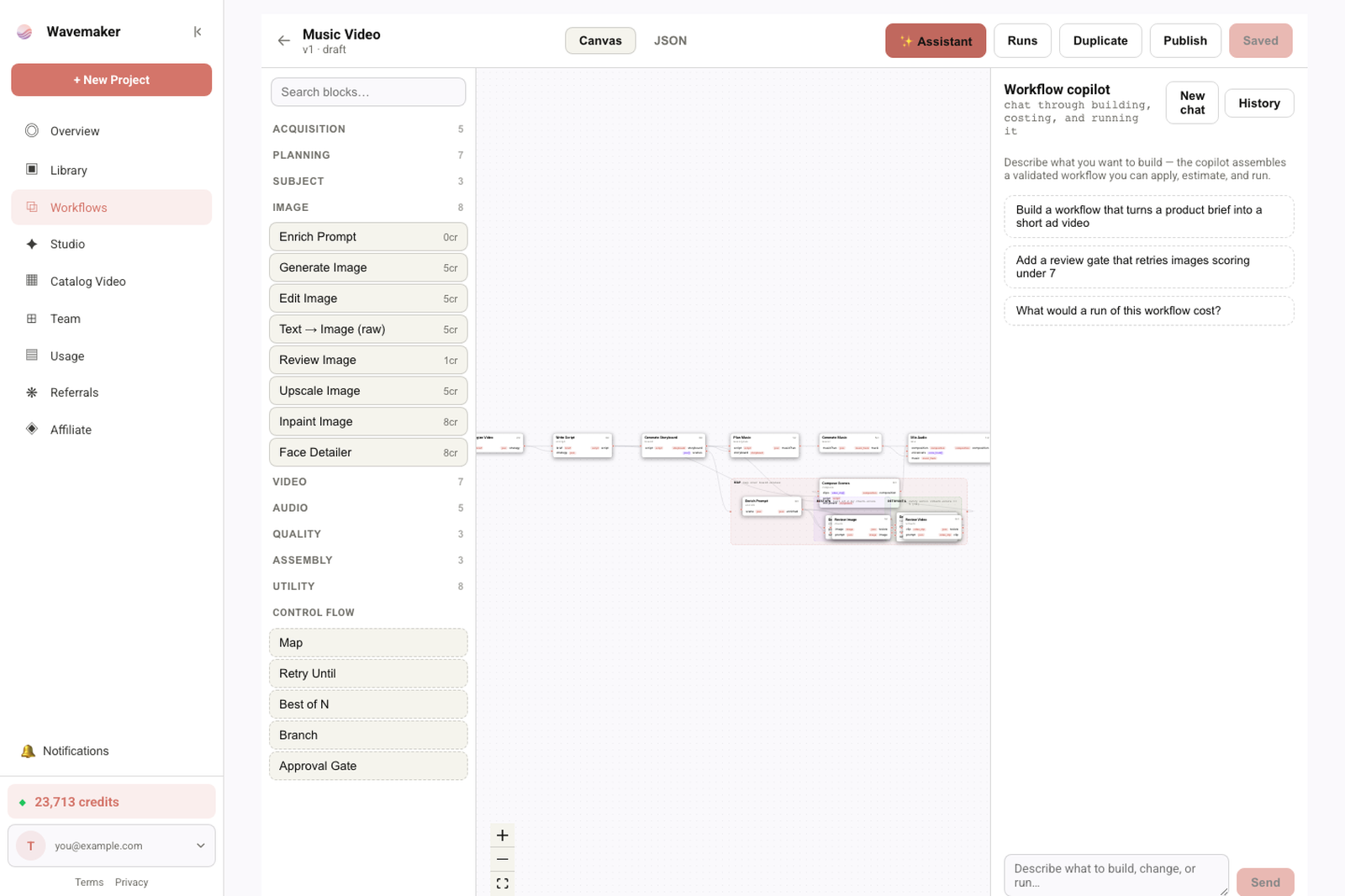
Workflow copilot — describe a pipeline and review the assembled graph.
Advanced step overrides bill overages—document hypotheses when raising steps, don’t crank blindly.
Epoch grids for motion
Still-image grid review skills transfer, but watch for:
- Temporal flicker on hair/cloth
- Camera behavior drifting off training moves
- Overfit loops that repeat training clip quirks
picking the right LoRA epoch applies; video mistakes are costlier at ~200+ credits per attempt.
Optional: blind A/B testing with motion prompt packs.
Binding into workflows
Library versions pin to video generation blocks compatible with wan/hunyuan backends. Published workflows keep pins stable—new training does not silently alter shipped apps.
Combine character image LoRAs (krea2) with video LoRAs (wan) in multi-block graphs; apply cast packs when roles multiply.
Relationship to Comfy video graphs
ComfyUI import does not execute custom video nodes. Transpile maps intent onto platform video blocks; foreign Wan LoRAs need Library import + runnable confirmation (Civitai import).
Credits and testing
Training holds cover the job; generating test clips bills normal video block credits. Plan evaluation batches before mass slug-runs—workflow API idempotency helps CI stay sane.
Voice and dialogue lanes
Narration clones use elevenlabs-path voice jobs (~30 credits) with consent—not video LoRA. See voice training with consent.
Consistency in long-form video
Video LoRAs help motion; they do not replace subject references or review gates. For holistic character continuity, link /blog/consistent-characters-across-scenes/ rather than duplicating that guide here.
Clip length and camera vocabulary
Wan clips need coherent motion within each training file—extreme jump cuts inside one clip teach impossible physics. Prefer one continuous move per clip unless your inference prompts always use montage grammar.
Audio in source clips
Strip music and dialogue from training clips when possible; background vocals leak into motion artifacts. Muted picture-only clips reduce entangled signals.
Dual-expert wan_pair decisions
Choose wan_pair when product docs indicate dual-expert benefits for your motion class—not by default to spend more credits. Document A/B against single video_lora when budget allows.
Preview in workflow before batch
Bind picked version, run three preview prompts (wide/medium/close), then scale slug-runs. Video credits exceed still tests—strength tuning on motion blocks saves rerenders.
Frame rate and resolution consistency
Train clips at the resolution and fps you expect in Wan blocks—upscaling training footage does not add detail. Match aspect ratio to delivery to reduce letterbox entanglement.
Joint workflows with image LoRA
Many productions bind krea2 character stills for storyboards and Wan video LoRA for motion—cast packs hold both pins. Do not assume one training job covers both.
Failure refunds and retries
Video jobs at ~200 credits hurt more on failure—verify dataset checklist before submit. Failures auto-refund holds but not your calendar time.
Field notes for video LoRA producers
Shoot or export clips at delivery aspect ratio; pillarboxing teaches black bars as subject. Prefer continuous takes; montage clips belong in editing, not single training files unless prompts always montage. Strip audio—music vocals leak motion. Caption camera verbs consistently. After pick, test three motion prompts before cast pack save. Remember image character LoRA on krea2 does not substitute for Wan motion—budget both jobs. Link stakeholders to /blog/consistent-characters-across-scenes/ for dialogue scenes, not this doc. Use epoch guide on video grids even when still previews look fine—flicker shows at playback. Plan Evaluate when motion subtle; pairwise votes beat single-frame hero picks.
Workshop scenarios
Fashion lookbook motion — 30 clips, consistent model scale, wan_pair if dual-expert helps else video_lora, pick epoch with stable hem motion. Product turntable — clips match turntable speed in prompts, bind before batch PDP video. Character walk cycle — do not rely on image LoRA alone; video dataset captures gait. Failed job after 200 cr hold — checklist rerun, captions fixed, refund already handled—retry once with hypothesis. Always link video role to /lora-training pricing before budget approval.
Extended production checklist
Normalize clip resolution and fps before upload; do not upscale in post to fake detail. Strip audio tracks entirely from motion datasets. Caption camera verbs consistently across all clips. Pick epochs using playback review; still thumbnails lie for motion. Bind video LoRA separately from krea2 image character LoRA—cast packs may hold both pins. Failures auto-refund training holds but not planning time—checklist before ~200 cr submit. Test three motion prompts post-bind before slug-run scale. For dialogue-heavy spots, link /blog/consistent-characters-across-scenes/ for casting strategy. Run Evaluate when motion differences are subtle. Document wan_pair vs video_lora choice in changelog.
Operator deep dive
Video training mistakes are expensive at ~200 credits base—treat checklist failures as hard stops. Clips should reflect how Wan blocks will be prompted: if production never uses dutch angles, do not train exclusively on dutch angles. Looping GIFs are poor teachers for generative video—use real temporal continuity. When combining image and video LoRAs, generate still storyboards with krea2 pins before motion batching—motion LoRA does not fix broken casting. Slug-run CI should include one motion smoke clip after bind changes. If clients supply licensed stock footage, confirm license allows ML training—not all stock permits LoRA. Pair ops with blind A/B when motion differences are subjective.
Closing principles for video LoRA programs
Budget video training (~200 credits default) with the same seriousness as location scouts—bad clips waste more than money, they waste calendar. Standardize clip naming and caption verbs so teams across sites upload compatible datasets. Keep audio off training media; music leaks are expensive to diagnose. Bind video LoRA only after playback review, then run strength tuning on motion blocks. Image krea2 character pins and Wan motion pins coexist in cast packs—document both in role sheets. Slug-run automation should smoke-test one clip after every bind change. Link long-form dialogue consistency to /blog/consistent-characters-across-scenes/ without duplicating that guide here.
Schedule Wan training when motion is a repeat cost center—one good video LoRA amortizes across dozens of slug-runs once epoch, weight, and cast pins are disciplined.
Production teams should storyboard motion requirements before clip capture—training cannot invent dolly moves you never filmed. Align clip aspect ratio with delivery to reduce letterbox artifacts Wan amplifies. When slug-runs fail after bind, verify video block backend, version pin, and weight before assuming the LoRA failed—many issues are graph configuration, not checkpoints. Pair every video training milestone with /lora-training credit tracking (~200 default) so finance sees motion as capital expenditure, not misc tooling. Revisit dataset preparation when grids show consistent flicker; caption fixes beat hyperparameter gambling.
Build a Wan clip intake checklist on your DAM upload form—resolution, fps, camera move, subject scale, no audio—so contractors cannot submit unusable training media. When motion still fails after epoch pick and weight tune, compare against no-LoRA control in Evaluate before blaming the base video model.
Document Wan training in your production wiki with links to /lora-training, this post, and epoch pick so freelancers do not cargo-cult clip counts without caption discipline.
Wan video LoRA is a production investment—treat failed motion grids like failed location scouts: fix inputs, do not argue with physics.
Motion training succeeds when producers treat clips like stock elements with metadata, not phone dumps uploaded Friday at 5 p.m.
Where to go next
- Train LoRA online without a GPU
- Image counterpart: Train a character LoRA
- Docs: Training Studio, Model assets § Training jobs
- Strength at inference: LoRA strength tuning
Frequently asked questions
- How much does video LoRA training cost on Wavemaker?
- Video LoRA jobs start around 200 credits at default steps; wan_pair dual-expert training starts around 300 credits. Failed jobs auto-refund; overages apply if you raise steps in advanced settings.
- How many clips belong in a video LoRA dataset?
- Between 6 and 200 moderated clips after ingest. Prefer consistent subject framing and the motion habits you expect at inference time.
- Is video LoRA training the same as image LoRA?
- No—different job types, backends (wan/hunyuan paths), evaluation habits, and workflow bindings. Image character LoRAs on krea2 do not replace video motion training.
- Do I still pick epochs manually?
- Yes. Each epoch emits comparable sample outputs; Wavemaker never auto-promotes the last epoch. Review grids before binding a version to video nodes.